
Sandtray Therapy in Georgia
Some stories are easier to show than to say.
Sometimes our feelings, memories, and experiences are difficult to put into words.
Sandtray therapy uses sand, miniatures, and symbolic expression to help children, teens, and adults explore their inner worlds in a creative, supportive space.
What Is Sandtray Therapy?
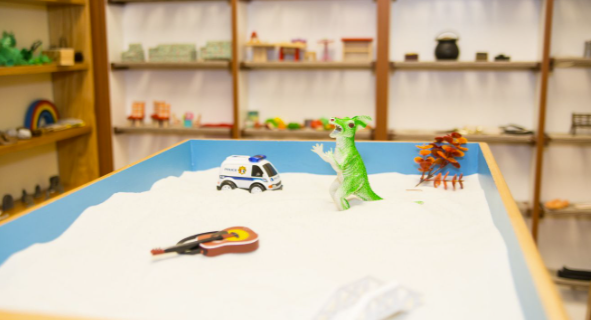
Sandtray therapy is a hands-on, expressive approach that uses a tray of sand and small objects or miniatures to create scenes, images, and stories.
A person might use figures, animals, buildings, natural objects, or other symbols to represent emotions, relationships, memories, challenges, or hopes for the future.
The goal isn't to create the perfect scene or explain every choice. Sandtray can offer another way to explore your experiences when talking about them feels difficult, overwhelming, or incomplete.
Your therapist supports the process with curiosity and care, allowing the meaning of your creation to come from you.
How Sandtray Therapy May Help
Sandtray can create opportunities for emotional expression, insight, and exploration across different ages and experiences.
Emotional Expression
Explore feelings, needs, memories, and inner experiences that may be difficult to name or explain.
Trauma & Difficult Experiences
Gently explore painful or overwhelming experiences through creative and symbolic expression, at a manageable pace.
Children & Teens
Support younger clients who may find it easier to communicate through play, imagination, symbols, and hands-on activities.
Anxiety & Emotional Overwhelm
Make room to explore worries, fears, stress, and inner conflict in a supported, tangible way.
Identity, Relationships & Self-Understanding
Explore relationship patterns, family dynamics, personal strengths, life transitions, and different parts of your experience.
A Small World, A Meaningful Story.
Sandtray therapy offers a way to express and explore experiences through images instead of relying only on conversation.
You may be invited to choose objects that stand out to you, arrange them in the sand, and notice what emerges.
Some people create scenes that represent real-life relationships. Others create imagined places or stories.
Your therapist won't assume that a symbol has one fixed meaning. Instead, the process makes room for your own understanding.
Exploring Your Inner World
Choose Your Symbols
Select miniatures or objects that feel meaningful, interesting, or connected to your experience.
Create Your Scene
Arrange objects in the sand, building an image, story, or world in your own way.
Explore What Emerges
Notice feelings, meanings, or connections at a pace that feels manageable to you.
This is one possible experience, not a fixed formula. Sandtray work is adapted to the individual.
Sandtray Isn't Just for Kids.
Sandtray can be adapted for different ages, developmental needs, and therapy goals.
For Children
Sand and miniature figures can provide a developmentally appropriate way to communicate feelings, explore experiences, and practice expression.
For Teens
Sandtray may offer an alternative to talking directly about complicated emotions, identity, relationships, or stressful experiences.
For Adults
Symbolic expression can help adults explore relationships, life experiences, inner conflict, and emotions that don't always come easily to words.
You don't have to explain everything perfectly to be understood.
Your Creation Belongs to You.
Sandtray isn't a test, and there isn't a right or wrong way to create a scene.
Your therapist isn't there to tell you what every object secretly means or make assumptions about your inner world.
Instead, sandtray invites curiosity, reflection, and expression, with your comfort, choices, and perspective guiding the experience.
Questions You Might Have
Sandtray may feel a little unfamiliar. Here's what can be helpful to know.
Do I have to talk about what I create?
Not necessarily. Your therapist can help determine how to approach reflection and discussion based on your comfort and therapy goals. You don't need to explain every detail of your scene.
Is sandtray therapy only for children?
No. Sandtray approaches may be used with children, teens, and adults. Your therapist will consider your age, preferences, and treatment needs.
Does every object have a specific meaning?
No. The same object may mean very different things to different people. Sandtray work is not about assigning a universal interpretation to your choices.
Your own experience and understanding help guide the exploration.
What if I don't know what to create?
That's okay. Some people begin with an idea, while others start by choosing objects that catch their attention. Your therapist can offer guidance without requiring you to make something specific.
Will every therapy session include sandtray?
Not necessarily. Sandtray may be one of several approaches used in therapy. Your therapist will work with you to determine what feels appropriate and helpful for your goals.
Do all Tiny Planet therapists offer sandtray?
Therapists vary in their training, techniques, and available resources. If you're interested in sandtray, our team can help you explore therapists who may be a good fit.
Some Stories Need More Than Words.
You don't have to know exactly what to say or how to explain everything you're feeling.
Sandtray therapy can offer another way to explore your experiences, express emotions, and build understanding through creativity and connection.